Home
Services
Blog
Booking
Contacts
0410 538 989
Our Blog
The beauty of shared experiences.
Home
Blog
Blog Post
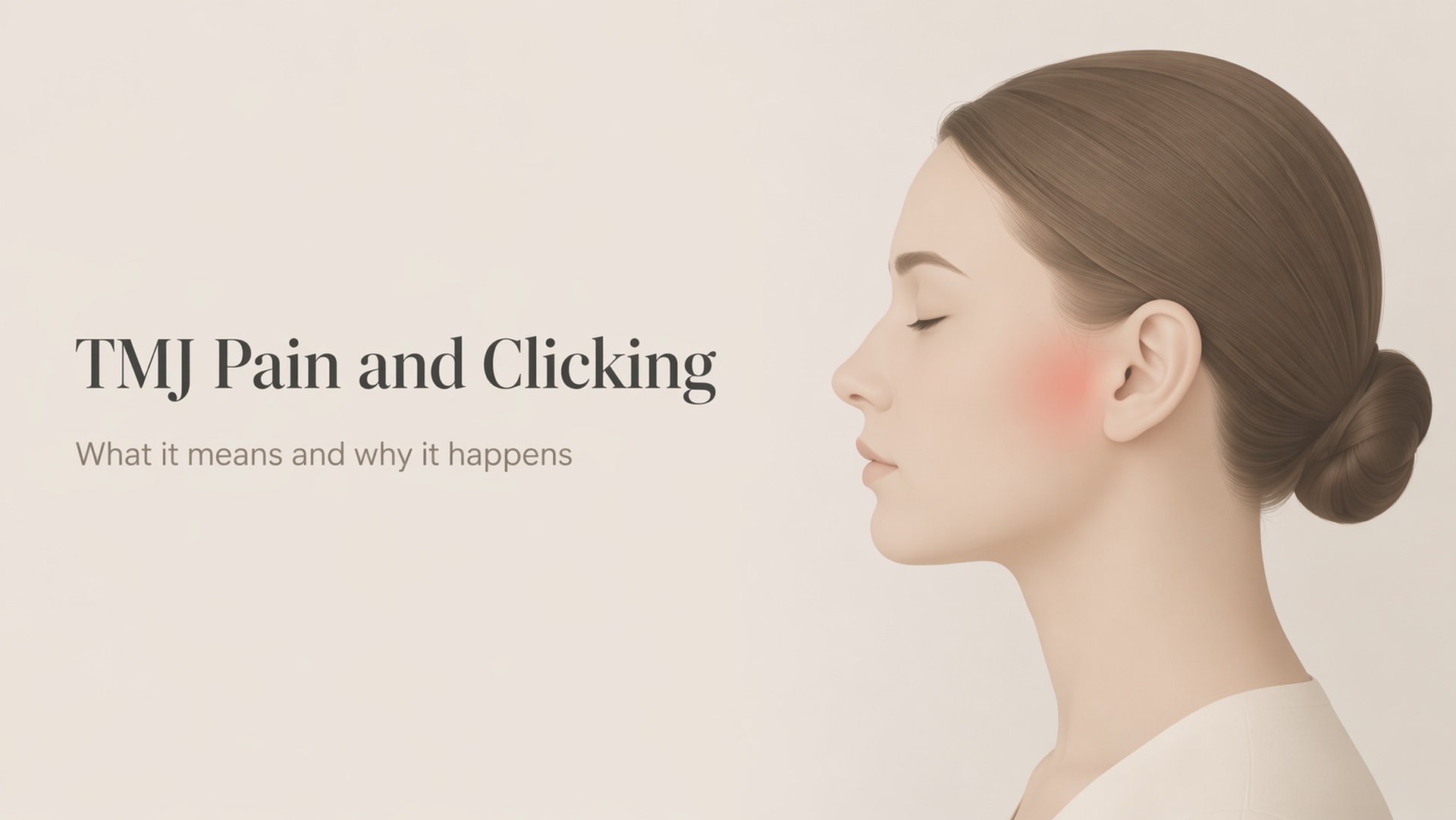
TMJ Pain and Clicking: What It Really Means
RMADN - Apr 18, 2026
<p>Jaw clicking, tightness, or discomfort is more common than you think. Here’s what it really means—and why it often links to tension in the neck.</p> <h2><strong>Jaw clicking, tightness, or discomfort?</strong></h2> <p>If your jaw clicks when you open your mouth, feels tight when you chew, or gets sore by the end of the day, you’re not alone.</p> <p>For many people, it starts subtly.<br /> A small click. A bit of stiffness. Something that doesn’t feel quite right.</p> <p>Over time, it can build into:</p> <ul> <li>jaw tension</li> <li>headaches</li> <li>neck tightness</li> <li>discomfort when eating or speaking</li> </ul> <p><strong>Jaw clicking isn’t random—it’s a sign that something isn’t moving as smoothly as it should.</strong></p> <hr /> <h2><strong>What is TMJ pain?</strong></h2> <p>TMJ stands for the <strong>temporomandibular joint</strong>—the joint that connects your jaw to your skull.</p> <p>It’s one of the most frequently used joints in your body. You rely on it for:</p> <ul> <li>talking</li> <li>chewing</li> <li>swallowing</li> </ul> <p>When the joint or surrounding muscles become overloaded, you may notice:</p> <ul> <li>clicking or popping</li> <li>tightness around the jaw</li> <li>soreness near the ear</li> <li>uneven or restricted movement</li> </ul> <p>This is something commonly seen in the clinic, especially in people managing stress or spending long hours at a desk.</p> <hr /> <h2><strong>Why does the jaw click?</strong></h2> <p>In many cases, clicking isn’t about damage—it’s about <strong>how the joint is moving</strong>.</p> <p>The movement has become slightly out of sync.</p> <p>This can happen when:</p> <ul> <li>surrounding muscles are tight</li> <li>one side is working harder than the other</li> <li>the joint isn’t gliding as smoothly as it should</li> </ul> <p>Clicking on its own isn’t always a concern. But when it becomes frequent or is paired with discomfort, it’s usually a sign that the system is under strain.</p> <hr /> <h2><strong>The connection most people miss: jaw and neck</strong></h2> <p>Your jaw doesn’t work in isolation.</p> <p><strong>The jaw and neck function as one system.</strong></p> <p>When the neck becomes tight—often from desk posture—it can influence:</p> <ul> <li>head position</li> <li>muscle tension patterns</li> <li>how the jaw sits and moves</li> </ul> <p>That’s why TMJ-related symptoms often come with:</p> <ul> <li>neck stiffness</li> <li>upper shoulder tension</li> <li>headaches</li> </ul> <p>In many cases, the jaw is reacting to what’s happening elsewhere.</p> <hr /> <h2><strong>Common triggers (that don’t feel obvious)</strong></h2> <p>TMJ discomfort usually builds gradually from everyday habits.</p> <h3><strong>Clenching and grinding</strong></h3> <p>Often happens without awareness, especially during stress or concentration.</p> <hr /> <h3><strong>Desk posture</strong></h3> <p>A forward head position changes how the jaw is supported and loaded over time.</p> <hr /> <h3><strong>Stress and mental load</strong></h3> <p>Tension often settles in the jaw, even if you don’t realise it.</p> <hr /> <h3><strong>Chewing patterns</strong></h3> <ul> <li>favouring one side</li> <li>frequent gum chewing</li> <li>harder foods</li> </ul> <p>These small habits can place repeated stress on the joint.</p> <hr /> <h2><strong>What tends to help long-term</strong></h2> <p>Short-term strategies can ease symptoms, but lasting improvement usually comes from addressing <strong>the broader pattern of tension</strong>.</p> <p>It’s less about fixing the joint itself and more about restoring balance around it.</p> <hr /> <h2><strong>How treatment can support this</strong></h2> <h3><strong>Remedial massage</strong></h3> <p>Can help:</p> <ul> <li>release tight jaw muscles</li> <li>reduce neck and shoulder tension</li> <li>improve overall muscle balance</li> </ul> <p>This often reduces pressure on the joint and improves comfort.</p> <hr /> <h3><strong>Dry needling</strong></h3> <p>Targets deeper areas of muscle tension that are harder to reach manually.</p> <p>In TMJ-related cases, it may help:</p> <ul> <li>reduce tightness</li> <li>improve movement</li> <li>ease tension that refers between the jaw, neck, and head</li> </ul> <hr /> <h2><strong>Why the neck is often part of the picture</strong></h2> <p>This is one of the most common patterns seen in practice.</p> <p>When the neck stays tight, the jaw often compensates.</p> <p>That’s why working on:</p> <ul> <li>the jaw</li> <li>the neck</li> <li>the upper back</li> </ul> <p>Together tends to lead to more consistent changes.</p> <hr /> <h2><strong>When to pay attention</strong></h2> <p>If you’ve been noticing:</p> <ul> <li>clicking that’s becoming more frequent</li> <li>jaw tightness or fatigue</li> <li>discomfort when eating or talking</li> <li>tension that spreads into your neck or head</li> </ul> <p>It may be a sign that things aren’t settling on their own.</p> <hr /> <h2><strong>How we can help </strong></h2> <p>At <strong>our clinic in Sydney CBD (just a 2-minute walk from Town Hall Station)</strong>, we focus on:</p> <ul> <li>treating the jaw and neck together</li> <li>reducing tension at the source</li> <li>restoring natural movement</li> </ul> <p>Using a combination of remedial massage and dry needling, we help you:</p> <ul> <li>feel more comfortable</li> <li>move more freely</li> <li>reduce recurring tension</li> </ul> <hr /> <h2><strong>A simple way to look at it</strong></h2> <p>Jaw pain isn’t just about the jaw.</p> <p>It’s about how different parts of the body are interacting and adapting over time.</p> <p>When that balance starts to improve, things often begin to feel easier—more natural.</p>
Other Articles
Dry Needling for Shoulder Pain in Sydney CBD
Sports Massage Sydney CBD Before and After Training
The greatest wealth is health.
Let us heal your pains.
Book Now