Home
Services
Blog
Booking
Contacts
0410 538 989
Our Blog
The beauty of shared experiences.
Home
Blog
Blog Post
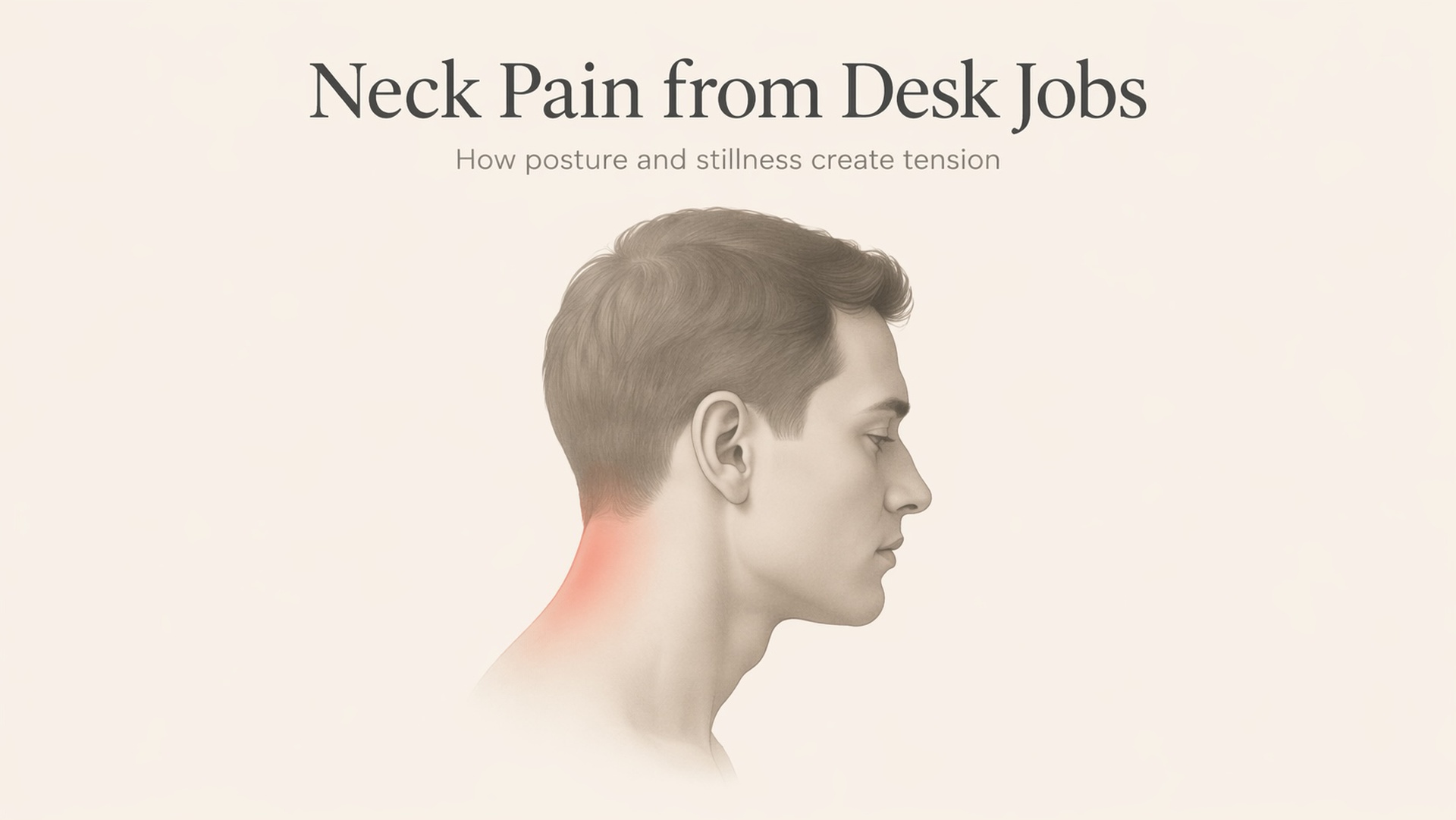
Neck Pain from Desk Jobs: Causes and Real Solutions
RMADN - Apr 16, 2026
<p>Neck pain from desk work is more than posture. Learn what’s really causing it—and how the right treatment can relieve tension and restore movement.</p> <h2><strong>Why Neck Pain Keeps Coming Back</strong></h2> <p>If you work at a desk, you’ve probably felt it—tightness in the neck, stiffness when turning your head, or that dull ache building through the day.</p> <p>Most people assume it’s just “bad posture”. But in reality, neck pain is usually the result of <strong>how long your body stays still</strong>, not just how you sit.</p> <p>Even with a “good” posture, holding the same position for hours places constant demand on your muscles. Over time, they become tired, tight, and sensitive.</p> <p>That’s why the pain keeps coming back.</p> <hr /> <h2><strong>What’s Really Causing Your Neck Pain</strong></h2> <h3><strong>Sitting Still for Too Long</strong></h3> <p>Your muscles rely on movement to stay healthy.</p> <p>When you sit for long periods, blood flow slows down, and muscles don’t get the recovery they need. This leads to tightness, fatigue, and that familiar heavy feeling in your neck and shoulders.</p> <hr /> <h3><strong>Subtle Forward Head Position</strong></h3> <p>You might not notice it, but your head often drifts slightly forward as you work.</p> <p>Even a small shift increases the load on your neck muscles. Over time, this adds up—especially by the end of a long workday.</p> <hr /> <h3><strong>A Common Pattern We See in Desk Workers</strong></h3> <p>In the clinic, we often see the same pattern:</p> <ul> <li>Tight chest and upper shoulder muscles</li> <li>Weak or underused upper back muscles</li> <li>Overworked neck muscles trying to compensate</li> </ul> <p>This creates a cycle where your neck is doing more work than it should—leading to ongoing tension.</p> <hr /> <h3><strong>Stress Builds Into the Body</strong></h3> <p>Work stress doesn’t just stay in your mind—it shows up in your body.</p> <p>Clenching, shallow breathing, or slightly raised shoulders can keep your neck muscles switched on all day without you realising it.</p> <hr /> <h2><strong>Why It Doesn’t Go Away on Its Own</strong></h2> <p>You might stretch, adjust your chair, or try to “sit straighter”—and it helps for a while.</p> <p>But if the underlying tension and muscle overload aren’t addressed, the pain tends to return.</p> <p>That’s because your body hasn’t had a chance to properly reset.</p> <hr /> <h2><strong>What Actually Helps (Simple and Realistic)</strong></h2> <h3><strong>Move More During the Day</strong></h3> <p>The goal isn’t perfect posture—it’s regular movement.</p> <p>A simple habit that works well:<br /> Take 30 seconds every 30 minutes to move. Stand up, roll your shoulders, or gently turn your neck.</p> <p>These small resets reduce the build-up of tension over time.</p> <hr /> <h3><strong>Improve Your Setup (Without Overthinking It)</strong></h3> <p>A few small changes can help:</p> <ul> <li>Screen roughly at eye level</li> <li>Keyboard close to your body</li> <li>Chair supporting your lower back</li> </ul> <p>It doesn’t have to be perfect—just more comfortable and natural.</p> <hr /> <h3><strong>Build Support, Not Just Flexibility</strong></h3> <p>Stretching can feel good, but long-term relief comes from helping your body support itself better.</p> <p>Simple strengthening of the upper back and neck support muscles can reduce how much your neck has to work during the day.</p> <hr /> <h2><strong>How Treatment Can Help You Feel Better Faster</strong></h2> <h3><strong>Remedial Massage</strong></h3> <p>Remedial massage works directly on the muscles that are holding tension.</p> <p>It helps to:</p> <ul> <li>Release tight areas</li> <li>Improve circulation</li> <li>Reduce that heavy, stiff feeling</li> <li>Restore easier movement</li> </ul> <p>Many clients feel immediate relief, especially when the tension has been building for weeks or months.</p> <hr /> <h3><strong>Dry Needling</strong></h3> <p>For deeper or more stubborn tight spots, dry needling can be very effective.</p> <p>It targets specific muscle knots (trigger points) and helps them release more quickly.</p> <p>This often leads to:</p> <ul> <li>Reduced pain</li> <li>Improved range of motion</li> <li>A noticeable sense of “lightness” in the neck and shoulders</li> </ul> <hr /> <h2><strong>When It’s Worth Getting Checked</strong></h2> <p>Most desk-related neck pain is muscular and responds well to the right treatment and movement habits.</p> <p>If something feels different to your usual pattern, or the pain isn’t improving, it’s always a good idea to check in with your GP for peace of mind.</p> <hr /> <h2><strong>Convenient Treatment in Sydney CBD</strong></h2> <p>If you’re working in the city, getting help doesn’t need to be complicated.</p> <p>Our <strong>Remedial Massage And Dry Needling</strong> clinic is located in <strong>Sydney CBD, just a 2-minute walk from Town Hall Station</strong>—making it easy to fit a session into your workday.</p> <p>We focus on treating desk-related neck and shoulder tension with:</p> <ul> <li>Remedial massage</li> <li>Dry needling</li> <li>Simple, practical advice you can use at work</li> </ul> <hr /> <h2><strong>Ready to Feel the Difference?</strong></h2> <p>Neck pain from desk work is common—but it doesn’t have to be something you just put up with.</p> <p>With the right approach, your body can feel lighter, more mobile, and far less tense—even during a busy work week.</p> <p>If you’re ready to stop managing the discomfort and start fixing it, we’re here to help.</p>
Other Articles
Dry Needling for Shoulder Pain in Sydney CBD
Sports Massage Sydney CBD Before and After Training
The greatest wealth is health.
Let us heal your pains.
Book Now